
Table of Contents
- Understanding Behavioral Therapy and Its Impact on Children
- Core Concepts of Behavioral Therapy for Children
- Deep Dive into Behavioral Therapy Techniques and Effectiveness
- Practical Steps to Access Behavioral Therapy for Your Child
- Advanced Topics in Behavioral Therapy: Parent Training and Generalization
- Frequently Asked Questions About Behavioral Therapy
- Empowering Your Child's Development Through Behavioral Therapy
Understanding Behavioral Therapy and Its Impact on Children
Behavioral therapy is a systematic, evidence-based approach focused on understanding how behaviors are learned and how they can be changed. By applying these scientific principles, skilled professionals create supportive environments where children can build meaningful skills. One of the most effective forms of behavioral therapy is Applied Behavior Analysis (ABA), which uses the science of behavior analysis to improve socially significant behaviors. Understanding the ABA therapy meaning is the first step for many families beginning this journey.
At its heart, modern ABA therapy is a child-led and naturalistic process, uniquely tailored to each child's individual needs. We design programs that look and feel like guided play, weaving learning into activities your child already loves. The core driver of this progress is positive reinforcement, a strategy that encourages desired behaviors by following them with a meaningful reward. This approach reduces challenging behaviors not through punishment, but by systematically teaching and strengthening more effective skills in communication, social interaction, and daily living.
Through this supportive, skill-building journey, children make strides in self-care and independence, gaining confidence in their ability to navigate the world. For families seeking ABA therapy near me or asking about a qualified child therapist near me, the goal is a partnership that brings compassionate, evidence-based support directly into their lives, fostering progress and promoting more joyful family moments.
Core Concepts of Behavioral Therapy for Children
At its core, behavioral therapy is a science-based approach to understanding and changing children's actions through reinforcement and environmental adjustments. Understanding these concepts helps parents make informed decisions about their child's care. While several therapeutic models exist, the most common approaches for children include Applied Behavior Analysis (ABA), Cognitive Behavioral Therapy (CBT), and Play Therapy. Each of these methods has a unique focus, making them suitable for different ages and challenges. We believe every child deserves a tailored approach, and learning about these core concepts is the first step.
The table below shows key differences between the most common behavioral therapy approaches.
| Approach | Core Focus | Age Range | Provider Credential |
|---|---|---|---|
| ABA Therapy | Behavior change through reinforcement | 2–12 years | Board Certified Behavior Analyst |
| CBT | Thought patterns and emotions | 8–18 years | Licensed therapist |
| Play Therapy | Emotional expression through play | 3–12 years | Registered Play Therapist |
ABA therapy is the most researched and widely used behavioral therapy for children with autism and developmental delays. According to ABA Hashtag, this approach breaks down complex skills into small, manageable steps and uses positive reinforcement to encourage meaningful progress. For families looking for ABA therapy for children in Spring, our programs focus on naturalistic, child-led learning. The process is data-driven, with therapists continuously tracking progress to adjust treatment plans. If you're searching for aba therapy near me, you'll find that qualified professionals, specifically Board Certified Behavior Analysts, create personalized programs that build communication, social, and daily living skills.
In contrast, CBT focuses on the connection between thoughts, feelings, and behaviors, making it an excellent fit for older children, typically those aged 8 to 18, dealing with anxiety or emotional challenges. This approach helps children identify and reshape negative thought patterns, leading to healthier emotional responses. Similarly, Play Therapy provides a safe, guided space for younger children, usually between the ages of 3 and 12, to express their emotions through play. A child therapist near me can use this method to help children process complex feelings without relying on verbal communication skills they may not yet have developed. We create a warm and supportive space in all therapeutic models to ensure children feel safe and understood.
Deep Dive into Behavioral Therapy Techniques and Effectiveness
Now let’s take a closer look at the specific techniques used in behavioral therapy and what the research says about their effectiveness. To understand the full scope of behavioral therapy, grasping the ABA therapy meaning is essential, as it forms the foundation for many of the techniques discussed below. When families explore behavioral therapy for autism, they often encounter several evidence-based approaches designed to build skills and encourage independence.
How Behavioral Techniques Are Applied in Sessions
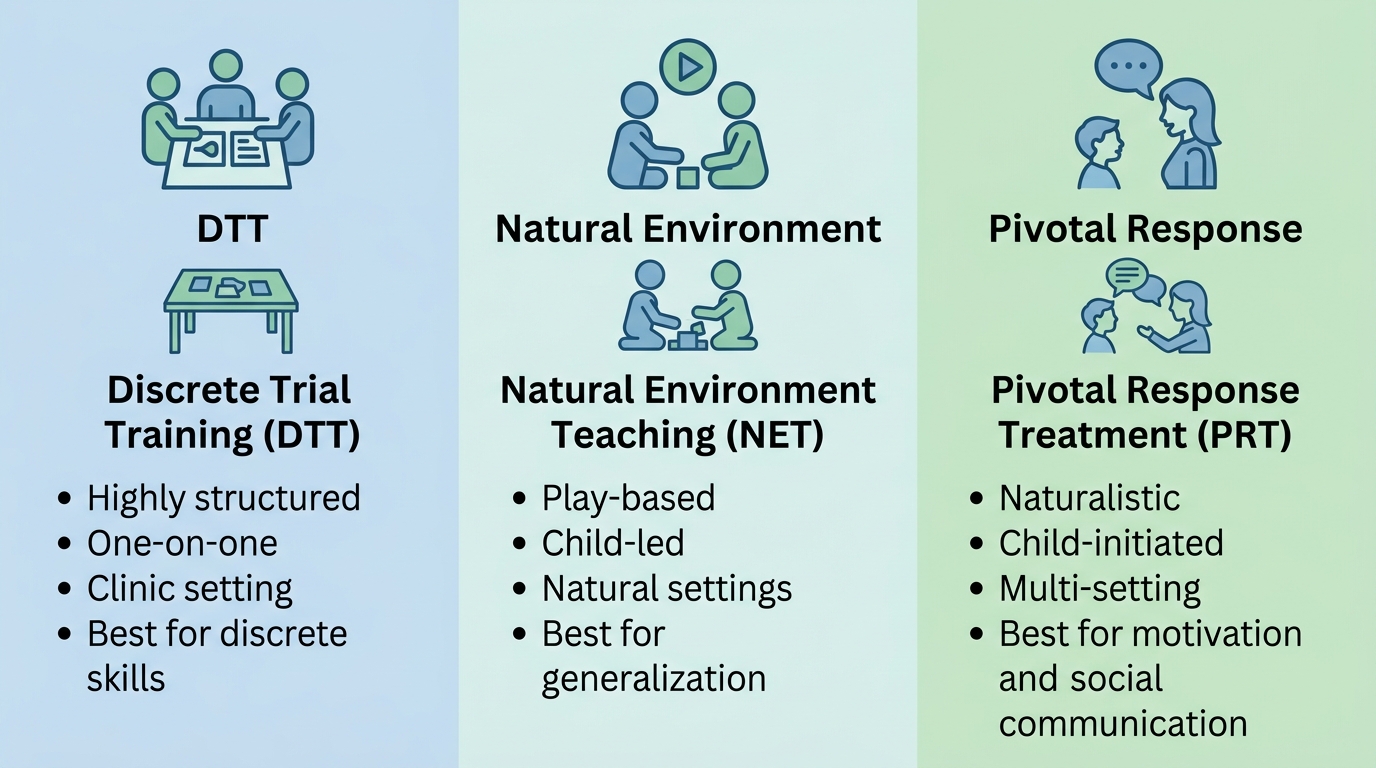
Three core techniques drive many behavioral therapy programs today. Discrete Trial Training (DTT) is a highly structured, one-on-one method where a therapist breaks skills into small, manageable steps—for example, teaching a child to match colors by presenting a red card and reinforcing the correct response. Natural Environment Teaching (NET), in contrast, uses play-based, child-led interactions in everyday settings to make learning meaningful; a therapist might seize a moment when a child reaches for a toy train to encourage requesting language like “train please.” Pivotal Response Treatment (PRT) builds on a child’s innate interests and self-initiation, targeting pivotal areas such as motivation and social communication. For instance, a therapist using PRT may follow a child’s lead during a game, pausing to create an opportunity for the child to initiate conversation or ask for a turn.
The Role of Data Collection and Measurement
Data collection is at the heart of effective behavioral therapy. Our therapists use several measurement strategies to objectively track a child’s progress and refine intervention plans. For example, trial-by-trial data records each response during structured teaching sessions, while interval recording measures behavior over predetermined time segments to capture frequency or duration. ABC data—documenting the Antecedent, Behavior, and Consequence—helps us understand why a behavior occurs by noting what happens before and after, revealing patterns that guide intervention.
- Trial-by-trial data: captures accuracy during discrete tasks
- Interval recording: tracks behavior within set intervals
- ABC data: illuminates the function of behavior
By reviewing these data points regularly, we can make informed adjustments, ensuring therapy remains responsive and meaningful for your child. This commitment to objective measurement is what separates evidence-based behavioral therapy from less structured approaches, and it gives families a clear window into their child’s growth.
Evidence for Effectiveness in Autism
Decades of scientific inquiry support the use of behavioral therapy for autism. Research published in journals indexed by the National Center for Biotechnology Information (NCBI) includes meta-analyses showing that children who receive intensive behavioral intervention often make significant gains in language, IQ, and adaptive behavior. One long-term outcome study tracked by NCBI found that many children maintained improvements in communication and daily living skills years after completing treatment. These findings underscore why behavioral therapy remains a widely recommended option for families.
The principles of ABA are not only effective for autism. According to the ABA Hashtag blog, behavioral strategies can also address other challenges such as feeding difficulties or attention issues, demonstrating the versatility of the approach. While the evidence base is robust, outcomes vary for each child, and no therapy can offer a guaranteed cure. What we can promise is a data-driven, compassionate approach that builds on each child’s strengths. Armed with this knowledge, families can make informed decisions about the right approach for their child. If you’re looking for a child therapist near me, our team at All About ABA offers personalized, child-led ABA sessions to meet your child’s unique needs. Families seeking aba therapy near me can find our centers across multiple states, ready to support your family’s journey.
Practical Steps to Access Behavioral Therapy for Your Child
Once you understand the life-changing benefits of behavioral therapy, the natural next question is, "How do I actually get started?" We know that navigating the world of therapy can feel overwhelming, but taking that first step is simpler than you might think. This guide will walk you through finding a qualified provider, understanding your financial options, and what to expect during the very first assessment, so you can move forward with confidence and clarity.
Finding a Qualified Provider
The most important step is finding a professional with the right training and credentials. For behavioral therapy, the gold standard is a Board Certified Behavior Analyst (BCBA). A BCBA holds a master's degree and has completed extensive supervised fieldwork, qualifying them to design and oversee your child's program. They are supported by dedicated professionals like Registered Behavior Technicians (RBTs), who deliver the day-to-day therapy under their close supervision.
This distinction is key because when you're looking for a child therapist near me or searching for aba therapy near me, the results can be varied. A BCBA is specifically trained in the science of behavior analysis, making them uniquely qualified for this type of therapy. To be sure, you can verify any professional's standing using the official behavior analyst certification registry, maintained by the Behavior Analyst Certification Board. This is your best tool for confirming the BCBA's credential is active and in good standing. At All About ABA, our passionate clinical teams are led by dedicated BCBAs who are committed to creating a warm and supportive space for your family.
Understanding Insurance Coverage and Costs
Tackling the cost of behavioral therapy is a common concern, but many families find that a significant portion of the therapy is covered. A crucial first step is to contact your insurance provider directly and ask for a detailed benefits check, specifically for Applied Behavior Analysis (ABA) therapy. Many states now have mandates requiring insurance companies to cover autism-related treatments, including ABA, so coverage may be available even if it’s not immediately clear from your plan documents. Don’t be discouraged by the initial phone call—we guide families through this process every day. At All About ABA, we are trusted by many insurance companies and accept a wide range of plans, and our compassionate intake team will manage the verification process on your behalf, clarifying any out-of-pocket costs before you commit.
Starting the Intake and Assessment Process
Taking the first step is as simple as reaching out. At All About ABA, beginning your child’s journey starts by contacting our team to schedule a comprehensive initial assessment. This meeting, led by a BCBA, is a play-based, naturalistic observation designed to see your child’s strengths and areas where they need support in a comfortable environment. We focus on your priorities, blending your deep knowledge of your child with our expertise to set measurable, meaningful goals.
From this assessment, we craft an individualized, results-driven, naturalistic, child-led therapy plan. This isn't a one-size-fits-all program; it's a personalized roadmap built specifically for your family, promoting first moments and family smiles everywhere. We'll walk you through the recommended hours, session schedules, and the fun, engaging activities we’ll use to help your child learn and grow. With your approval of the plan and insurance authorization in hand, your child can start therapy quickly, with our team right by your side. To begin your child’s journey, contact us today.
Advanced Topics in Behavioral Therapy: Parent Training and Generalization
Building on fundamental behavioral therapy skills, parent training is a core advanced component that equips you to act as a co-therapist. At All About ABA, we create a warm and supportive space where every need is heard and every step is taken with care—because your journey matters. Effective training helps you reinforce new skills at home, turning daily moments into growth opportunities. By learning the same science-based strategies our clinicians use, you create consistent practice and reinforcement that extends the impact of behavioral therapy far beyond the session.
| Technique | Structure | Setting | Best For |
|---|---|---|---|
| Discrete Trial Training (DTT) | Highly structured, one-on-one | Clinic or table-top | Teaching discrete skills |
| Natural Environment Teaching (NET) | Play-based, child-led | Natural environment (home, clinic) | Generalization of skills |
| Pivotal Response Treatment (PRT) | Naturalistic, child-initiated | Home, school, community | Motivation and social communication |
Generalization means transferring skills from therapy to home, school, and community settings. According to the ABAI behavior analysis association, practicing skills across multiple environments and with different people is essential for lasting progress. In our results-driven, naturalistic therapy, we embed generalization opportunities from the very first session. We intentionally teach skills in various settings, with different people, and across times of day to help your child adapt. For example, a communication skill first learned in the clinic might be practiced at home with siblings, then at school with peers. Our team coaches you on how to prompt and reinforce these behaviors naturally, ensuring they become part of everyday life.
As noted by ABA Hashtag, parent involvement is crucial for skill maintenance and generalization. When families search for aba therapy near me, they find that parent coaching is a key service. A child therapist near me who includes caregivers in sessions helps your child apply learning at the grocery store or during playtime. Consistency and reinforcement from you make all the difference. We’re here to support your child’s journey. Start Your Child’s Journey with All About ABA and see the impact of family-centered care.
Frequently Asked Questions About Behavioral Therapy
Many families have questions about behavioral therapy and how it can help their child. Here are answers to some of the most common concerns we hear from parents like you.
What is behavioral therapy? Behavioral therapy is a form of ABA therapy that uses positive reinforcement to teach new skills. Our child-led, naturalistic approach makes learning fun and fits your child's unique interests.
How does behavioral therapy help children with autism? The NCBI biomedical database shows ABA therapy can improve communication and daily living skills for children with autism. We build on your child's strengths to foster confidence and independence.
Is behavioral therapy covered by insurance? Yes, behavioral therapy is trusted by many insurance companies. All About ABA accepts plans in Arizona, in Georgia, in New Jersey, and other states, and we help you verify coverage before you begin.
How do I get started with behavioral therapy for my child? Simply contact us for a free consultation. Our team will guide you through the intake and assessment, then create a personalized plan tailored to your child's needs.
What makes your behavioral therapy different? Our therapy is results-driven, naturalistic, and child-led, and we create a warm, supportive space where every step is taken with care. We focus on Promoting First Moments and Family Smiles Everywhere.
Empowering Your Child's Development Through Behavioral Therapy
Behavioral therapy is a scientific, evidence-based approach that empowers your child to develop vital skills. At All About ABA, we provide ABA therapy—a compassionate, child-led method tailored to each child's strengths. According to ABA Hashtag, ABA therapy uses positive reinforcement to teach communication, social, and daily living skills. This behavioral therapy approach includes family collaboration, with strategies for home support. Whether you're seeking ABA therapy near me in Phoenix or a child therapist near me at our Atlanta center, we create a warm, supportive space. We accept many insurance plans, making care accessible.
Resources
- Find Trusted ABA Therapy for Children in Spring
- Learn ABA Therapy Meaning with Complete Guide
- Clarify Whether ABA Therapy Focuses Only on Autism
- Understand ABA Therapy Meaning in Simple Terms
- Find a Complete Guide to Pediatric Occupational Therapy
- Discover In-Home ABA Therapy for Children
- Explore the Benefits of ABA Therapy for Children
- Find Behavior Analyst Certification Through the BACB
- Explore Behavior Analysis Resources at ABA International
- Explore NCBI for Biomedical Database Access